
Visual nostalgia and the art of reinvention
Some images remain remarkably specific long after their original context has faded.
One of my most persistent childhood visual memories comes from a stop-motion short that aired during Sesame Street. An anthropomorphic orange performs Carmen under a spotlight, with daisy-petal eyelashes, a walnut nose, and a rubber-band mouth. I found it strange and unsettling as a child, and the image stayed recognizable decades later.
What remained in memory was not every detail of the original scene. It was a surprisingly small collection of visual cues: the petals, the walnut, the rubber band, the theatrical face, and the slightly uncanny relationship between familiar materials.
This still-life study began by separating those details from the image that originally contained them.

What survives a visual memory
Memory is selective.
The original short contains a character, performance, setting, movement, sound, and narrative. But most of that was unnecessary for the image to remain recognizable to me.
Three physical elements carried much of the identity: daisy petals, a walnut, and a rubber band.
Reduced to those materials, the reference becomes almost schematic. Petals establish the eyes. The walnut creates a nose. A curved band is enough to suggest a mouth. Their placement does as much work as the objects themselves.
That reduction became the starting point for the study.
Rather than reproducing the original frame, the question became how little of it needed to remain before the reference disappeared.
Reconstruction without replication
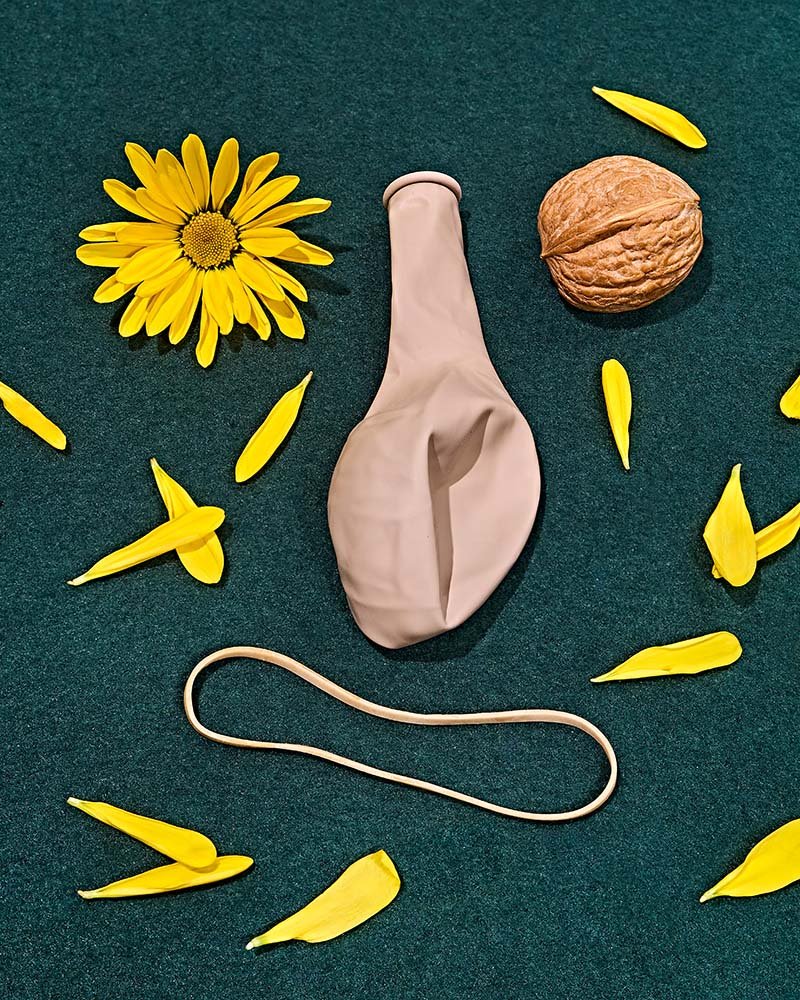
The original orange was replaced with a neutral balloon. The kitchen environment disappeared. The palette shifted toward a deep green background, and the lighting became more controlled and deliberately theatrical.
The identifying elements remained, but the visual language around them changed.
That distinction was important. A direct recreation would primarily demonstrate resemblance to the source. Rebuilding the image from its component parts created more room to examine why the source remained recognizable in the first place.
The balloon retains the rounded form necessary for the face, but removes the literal fruit reference. The petals, walnut, and rubber band become more conspicuous once they are separated from their original context. Materials that once served a character begin to operate as individual still-life elements.
The reconstruction relies on recognition without requiring imitation.

Deconstruction changes the reference
Separating the components also changes how they are perceived.
A daisy petal removed from a flower becomes a small graphic shape. A walnut can function as texture, volume, and irregular form before it reads as a nose. A rubber band is an ordinary object until its curve becomes a mouth.
The original image assigns each material a role immediately.
Still life allows those roles to loosen.
The components can be shown individually, reorganized, or returned to their familiar positions. Moving between those states makes the construction of the face more visible and turns recognition itself into part of the subject.
The source is still present, but it no longer controls the entire image.
Familiar enough to recognize, different enough to become something else
Reinterpretation depends on deciding what is essential and what can change.
Remove too many identifying cues and the connection becomes arbitrary. Preserve too much and the result becomes reproduction.
Here, the materials provide continuity while changes in color, surface, lighting, setting, and subject create distance from the original. The reconstructed face remains recognizable because its visual grammar survives even though most of the surrounding image does not.
That relationship between familiarity and change is what interests me about visual nostalgia.
A remembered image does not need to be recreated exactly to remain present. Sometimes a few materials, proportions, or gestures are enough to carry it forward into an entirely different image.
This series takes a strange childhood reference apart, identifies what made it persist, and rebuilds it as a still life.
The memory remains visible.
The image around it is new.
Deconstruction changes the reference
Separating the components also changes how they are perceived.
A daisy petal removed from a flower becomes a small graphic shape. A walnut can function as texture, volume, and irregular form before it reads as a nose. A rubber band is an ordinary object until its curve becomes a mouth.
The original image assigns each material a role immediately.
Still life allows those roles to loosen.
The components can be shown individually, reorganized, or returned to their familiar positions. Moving between those states makes the construction of the face more visible and turns recognition itself into part of the subject.
The source is still present, but it no longer controls the entire image.
Familiar enough to recognize, different enough to become something else
Reinterpretation depends on deciding what is essential and what can change.
Remove too many identifying cues and the connection becomes arbitrary. Preserve too much and the result becomes reproduction.
Here, the materials provide continuity while changes in color, surface, lighting, setting, and subject create distance from the original. The reconstructed face remains recognizable because its visual grammar survives even though most of the surrounding image does not.
That relationship between familiarity and change is what interests me about visual nostalgia.
A remembered image does not need to be recreated exactly to remain present. Sometimes a few materials, proportions, or gestures are enough to carry it forward into an entirely different image.
This series takes a strange childhood reference apart, identifies what made it persist, and rebuilds it as a still life.
The memory remains visible. The image around it is new.