
“You have a weird brain”: recognizing a visual point of view
“You have a weird brain.”
The comment came during a portfolio review with the director of photography of a nationally circulated magazine. It was unexpected enough to stay with me.
At the time, I had been thinking about my portfolio largely in terms of polish. I wanted the work to feel professional, technically resolved, and recognizable as commercial photography. Those things still matter. But the review drew attention to something else already present in the images: the choices that made them less predictable.
The comment mattered because it gave a name to something I had been treating as incidental.
Naming something already present
Looking across the work, certain impulses kept recurring.
Unlikely objects appeared together. Familiar materials became slightly strange once removed from their ordinary context. Humor sat beside precision. Some images relied on visual tension or a small degree of discomfort rather than straightforward beauty.
None of this had been established as a deliberate style. It was simply where my attention tended to go.
The portfolio review changed the way I understood those instincts. Instead of asking whether they should be edited out in favor of something more conventionally commercial, I began considering whether they were the part of the work most worth protecting.
A visual point of view is not necessarily something imposed on the work from the beginning. Sometimes it becomes visible through repetition. The same kinds of decisions appear across different subjects before there is language for why.
Recognition comes after the pattern.
Polish and authorship are different questions
There is nothing inherently distinctive about an image being polished.
Commercial photography needs control. Products need to be represented accurately. Materials need to read. Lighting, composition, color, and post-production all need to support the object and the assignment.
But technical resolution and authorship are not the same thing.
An image can be beautifully executed and still feel interchangeable. Another can be equally resolved while carrying a decision that makes it difficult to imagine coming from anyone else.
That distinction became increasingly important to me.
The goal was not to abandon polish in favor of eccentricity. It was to stop treating professionalism as a reason to smooth away the stranger decisions that gave the work specificity.
The recurring decisions became more useful than the label
“Weird” is not particularly precise as an aesthetic description.
What became more useful was identifying the actual decisions underneath it.
There was an interest in familiar objects removed from their normal hierarchy. Ordinary materials could be treated with the seriousness of luxury objects. Polished product imagery could contain humor without becoming a joke. Two things could belong together visually while feeling conceptually mismatched. An image could be attractive and slightly uncomfortable at the same time.
Those tendencies created more useful questions than simply asking whether an idea was unusual.
What relationship between these objects makes the image worth making? What happens when something disposable is treated as precious? How much familiarity can an object lose before it becomes abstract? What makes an unexpected pairing feel deliberate rather than arbitrary?
Those questions began to form a more recognizable visual language.
Recognition followed the same thread
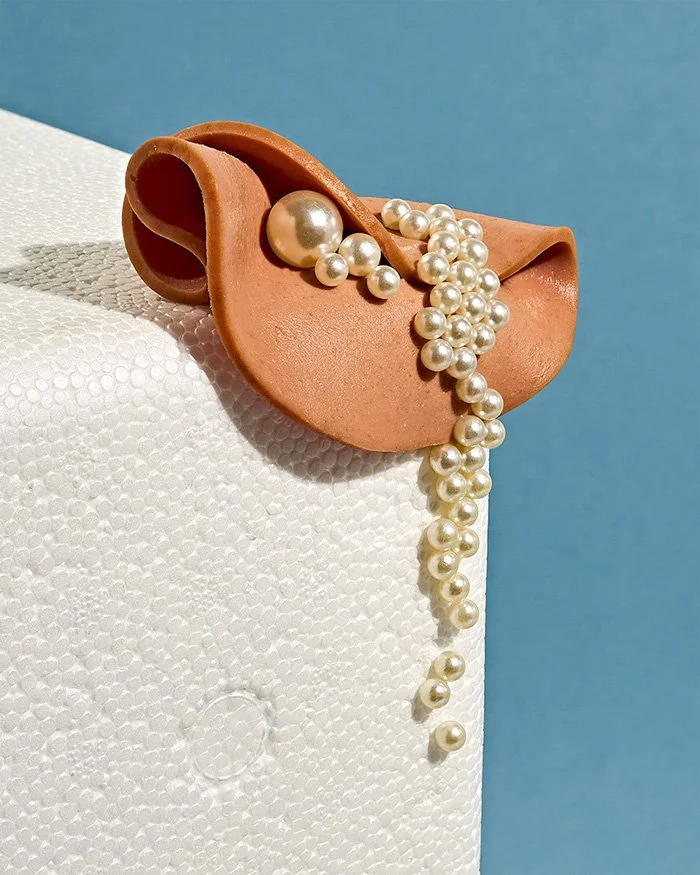
One of the images that came to represent that direction was a still life of bologna, pearls, and Styrofoam.
The materials are familiar and culturally loaded in very different ways. Bologna is inexpensive, processed, ordinary. Pearls carry an almost opposite set of associations. Styrofoam sits somewhere else again: disposable, industrial, and visually pristine.
The image placed second in the Food and Still Life category of the 2024 APA Awards.
What mattered about that recognition was not that it proved unusual work would always succeed. It was that the image being recognized was built from the same instincts the portfolio review had identified.
The strange part was not getting in the way of the work.
It was part of the work.
Useful criticism gives language to what already exists
The most useful creative feedback does not always tell someone what to make next.
Sometimes it identifies a pattern that is already there.
“You have a weird brain” stayed with me because it did exactly that. It turned a collection of instincts into something I could recognize, examine, and develop more deliberately.
The phrase itself matters less now than what it revealed.
A point of view was already beginning to appear in the work. The turning point was learning to see it.