
Cohesion + tension in product photography
Cohesion and tension can operate at the same time in a still-life image. Cohesion gives seemingly unrelated objects enough visual logic to belong together. Tension preserves the differences that make the pairing interesting.
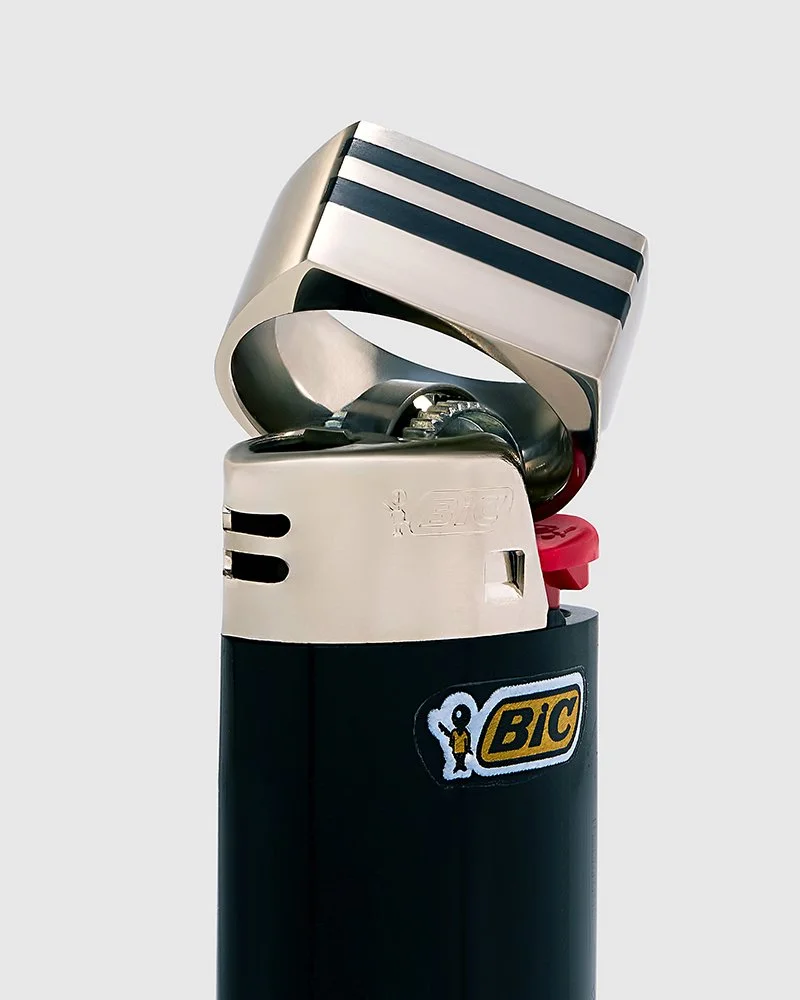
In this image, a sculptural striped ring is paired with a Bic lighter. The objects share enough formal qualities to hold the composition together, but their associations are almost opposite. One is designed to be kept and valued. The other is designed to be used and discarded.
The image depends on both relationships at once.
Cohesion through shared details
Before the contrast between the objects can become interesting, there needs to be a reason for them to occupy the same frame.
Both objects contain metal. Both use strong vertical striping. Both are grounded by black surfaces, with enough similarity in shape, color, and finish to establish a visual relationship.
Those shared details give the pairing structure. The objects do not need to come from the same category because they already speak to one another formally.
Cohesion in this case is less about making the objects look alike than giving the eye enough evidence to understand why they have been placed together.
Tension through difference
Once that relationship is established, the differences between the objects become more pronounced.
The ring is sculptural, decorative, and intended to last. The lighter is inexpensive, familiar, and ultimately disposable. One carries associations of adornment and value; the other belongs to an ordinary category of functional objects.
Placing them together does not erase that distinction. It makes it more visible.
The shared stripes and materials pull the objects toward one another while their meanings push them apart. That opposition gives the image a second layer beyond the formal composition.
Familiarity makes the contrast stronger
The pairing works because both objects remain recognizable.
The lighter does not become precious simply because it appears beside jewelry, and the ring does not become disposable because it shares visual characteristics with an everyday object. Their existing identities remain intact.
That familiarity matters. The conceptual distance between the objects is immediately legible because both already carry such different associations.
The formal similarities then become more surprising. Metal, stripes, black surfaces, and vertical form create a relationship between objects that would otherwise have very little reason to meet.
The image holds between the two
Too much cohesion would make the pairing predictable. Too much difference would make it arbitrary.
The useful tension comes from giving the objects enough in common to establish a visual relationship while preserving enough difference for that relationship to remain unexpected.
Neither quality is doing the work alone.
Cohesion provides the structure. Tension gives the structure something to hold.
The image exists in the space between the two.
Planning a campaign or product shoot?
I help brands define the image library they actually need before production begins, then build still-life and product imagery designed to work across the full rollout.